You've probably heard that a puddle under your car is always panic-worthy. Here's what the data actually shows. An oil spill under car can range from a few drips of seepage you can politely ignore for months to a leak that costs three figures to repair. The way you read the stain tells you which one you're dealing with, and that skill takes about ten minutes to learn.
Read the Stain Before You Panic
Most of what people call a spill is a slow leak that deposits a few tablespoons overnight. Park over a clean piece of cardboard and let the car sit for a few hours. Color, texture, and location tell you more than any code reader will.
Clear or amber and thin: brake fluid or old fuel, not engine oil. Dark brown or black and slick: engine oil. Red or pink: transmission fluid or power steering fluid. Green or orange: coolant. If the spot is dead center under the engine, the oil pan gasket, drain plug, or front main seal is the usual suspect. If it sits toward the rear, think rear main seal or a valve cover gasket on transverse-mounted engines.
Contain the Spill in the First Hour
Kitty litter, baking soda, or commercial oil absorbent all work. Spread a generous layer over the stain, let it sit for fifteen minutes, sweep it up, and repeat. Then lay a drip pan under the car. A fifteen-dollar oil drain pan from any auto parts store catches what is still leaking, so you can keep driving short distances while you line up the repair.
Don't hose the oil down the driveway. Concrete stains permanently, and oil running toward a storm drain can earn you fines in most municipalities.
Science Corner: Why the Same Leak Looks So Different
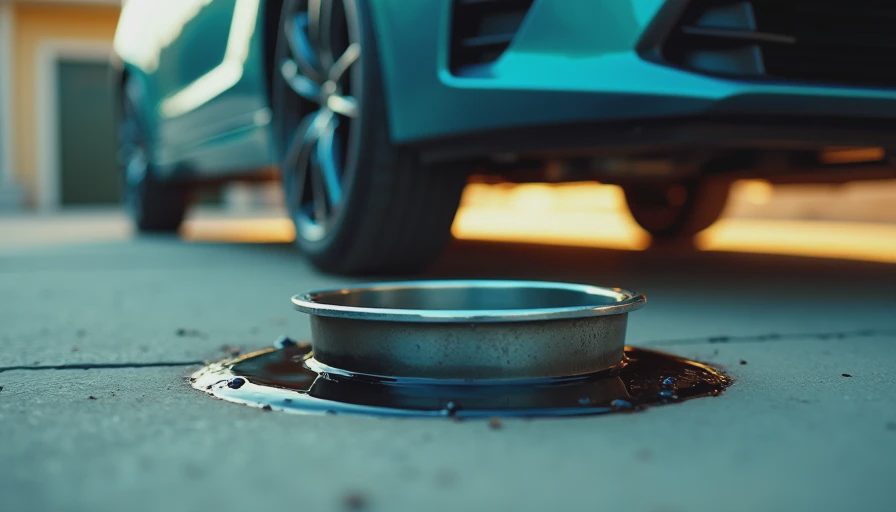
Oil viscosity changes how fast a leak spreads. A 5W-20 conventional oil flows thin and spreads wide on pavement, making a small leak look enormous. A 0W-40 full synthetic is thicker at operating temperature, so it pools instead of spreading. The exact same leak from the exact same gasket can produce a stain half the diameter. That matters when you estimate severity. Park on fresh cardboard and measure the drip rate over twenty-four hours. A few drops is a weep. A quarter-sized puddle is a leak. A full pool needs attention this week, not next month.
How Much Does an Oil Spill Under Car Cleanup Really Cost?
The cleanup is the cheap part. DIY with kitty litter and degreaser runs twenty to fifty dollars. A commercial driveway cleaner plus a pressure washer rental runs fifty to a hundred and fifty. If you hire a detailing shop to handle stained concrete, budget a hundred and fifty to four hundred, depending on how long the oil has set in.
The repair is the real number. A drain plug gasket is a five-dollar part and fifteen minutes of your time. An oil pan gasket runs a hundred and fifty to four hundred installed, depending on the vehicle. A rear main seal is the expensive one: eight hundred to fifteen hundred on many trucks because the transmission has to come out. The cheapest oil spill under car is the one you catch early. A small gasket leak that costs two hundred dollars today becomes a twelve-hundred-dollar rear main seal job if the leak worms its way toward the bell housing and the oil level keeps dropping. And if you catch it before the low oil pressure light comes on, you skip the towing bill and the risk of running a bearing.
Find the Source Before You Refill
Here's the trap: you cannot fix an oil spill under car by simply topping off the oil. That just keeps you driving with a worsening leak. If you remember one number from this post, make it this one: check the dipstick. A chronically low oil level is what turns a forty-dollar valve cover gasket into a four-thousand-dollar engine replacement.
To locate the source, clean the underside with brake cleaner, then use a UV dye kit. Fifteen dollars for the dye, ten for a UV flashlight, and the leak glows bright green at the exact point of origin. No guessing, no degreasing three times.
How Long Can You Drive With an Active Leak?
A weep that leaves a few drops on cardboard overnight is close to cosmetic. If the drip rate stays under a teaspoon, you can drive a few hundred miles while you order the gasket and wait for a free weekend. Check the dipstick every time you fuel up. If the level stays between the hash marks, the leak is slow enough that it isn't damaging anything yet.
Once you lose a quart every thousand miles or less, the math changes. A modern engine holds five to eight quarts, so that quart every thousand miles means you are down fifteen to twenty percent of your oil capacity between changes. At that rate, the additive package gets consumed faster than it was designed to be replenished, and wear metals show up in used-oil analysis long before you hear a knock. Catching it at the gasket stage is the difference between a two-hundred-dollar repair and a four-figure one.
The Bottom Line
An oil spill under car is usually a manageable repair if you catch it within the first few hundred miles. Read the stain, contain the mess, measure the drip rate, and find the source while the fix is still a gasket and not an engine. The engine is telling you what it needs early; better to listen now than to hear silence at the worst possible moment. When you're ready to choose the right oil for the refill, read the spec, not the bottle.




No letters yet — pray write the first.