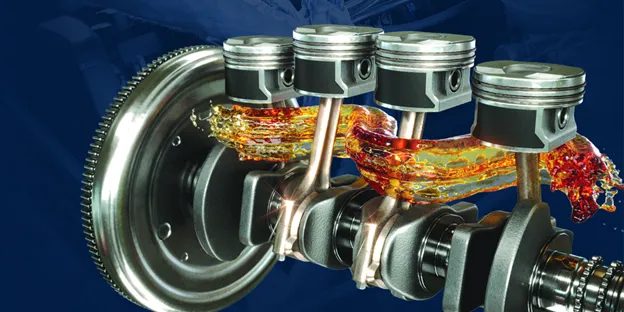
At a fundamental level, all engine oils serve the same function. Their primary role is to lubricate an engine's moving components, minimize friction, and shield engine parts from wear and tear. They also provide heat dissipation and cooling capabilities.
That said, engine oil formulas are not interchangeable. Every engine is built differently and therefore demands a specific oil formula to perform correctly. This includes particular requirements such as oil viscosity, temperature stability, and compatibility with sealing materials. For this reason, the base oils and additives that make up an engine oil formula carry enormous significance.
One of the key considerations when selecting the appropriate lubricant for your engine is OEM specifications and approvals. What exactly does this entail? Read on to find out.
To assist customers in selecting the right lubricants for their vehicles and maximizing vehicle longevity, various institutions have developed oil quality and performance standards.
Among the most widely recognized is the American Petroleum Institute (API) service classification, which applies primarily to lubricants developed for vehicles designed in North America and Asia.
Vehicles manufactured in Europe generally adhere to ACEA European Oil Sequences — a distinct set of standards established by the European Automobile Manufacturers' Association (ACEA).
The Japanese Automotive Standards Organization (JASO) maintains a separate framework of engine lubrication standards specifically for vehicles produced in Japan.
Lubricant manufacturers qualify their products by passing laboratory and engine tests defined under each classification. Engine oils that successfully complete one or more of these performance tests are then categorized by the manufacturer and are said to deliver baseline protection across a wide range of engines.
Beyond these broad classifications, most OEMs establish their own lubricant specifications tailored to their vehicles. Some examples include:
These OEM-specific requirements make logical sense, as the original equipment manufacturer has the deepest understanding of what its engines need.
When an engine oil is said to meet OEM requirements, it means the oil has been formulated in accordance with the specifications that the OEM has published. Put differently, the lubricant formula satisfies the OEM's designated tests and criteria.
However, meeting OEM requirements is not the same as receiving OEM approval.
Once a lubricant has been engineered to align with official OEM specifications, the manufacturer may submit it for formal approval directly from the original equipment manufacturer. The OEM then conducts rigorous laboratory testing to verify that the lubricant matches the properties described in its information sheet.
Following a comprehensive lube evaluation, the original equipment manufacturer grants its official approval.
The extent of lubricant testing is what fundamentally distinguishes oils that merely meet OEM standards from those that carry official original equipment manufacturer approval. Consequently, a claim that a product 'meets industry standards' is a considerably weaker indicator of quality and performance than formal approval from the original engine manufacturer.
Official OEM approval signals lubricant quality and dependability. It demonstrates that the lubricant manufacturer produces products aligned with the most rigorous OEM standards and commits resources to thorough laboratory testing.
Valvoline offers an extensive lineup of premium products, encompassing engine oils, gear and axle oils, coolants, and hydraulic oils, serving diverse industries ranging from automotive to agricultural. Every Valvoline product is specially formulated to satisfy the highest industry standards and to comply with original equipment manufacturer requirements.
As one notable example, Valvoline is the only engine oil manufacturer capable of conducting all five required gasoline tests for API and ILSAC gasoline categories within its own engine test labs.
Furthermore, our products — including engine oils, gear oils, transmission fluids, and coolants — carry OEM approval. A few examples include:
For complete details on our OEM-approved lubricants, please refer to our Product Information (PI) sheets.
Although choosing an OEM-approved lubricant may appear to be a costlier option upfront, it delivers significant advantages. OEM-approved engine oils offer maximum protection for your engine, extend its service life, and lower long-term maintenance expenses. They are also purpose-matched to your vehicle, which reduces the likelihood of warranty-related complications.
To identify the right Valvoline lubricant for your specific vehicle, reach out to a Valvoline dealer in your region or use our online Lubricant Advisor.