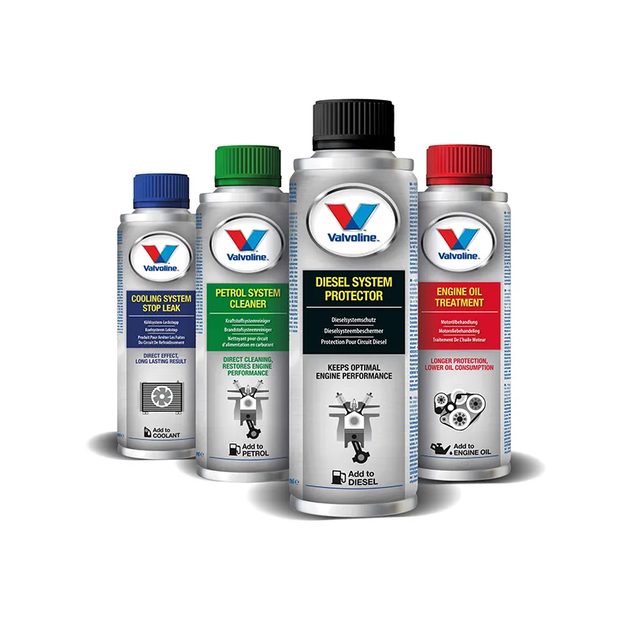
As the name implies, oil additives are chemical compounds deliberately formulated to be blended into engine oil, typically to enhance or eliminate specific characteristics of the product. In Valvoline's case, our additive-enhanced oils deliver superior properties that keep engines performing reliably across all conditions. Among the most valuable benefits oil additives provide are:
Additive-enhanced oils strengthen the oil's lubricating performance, meaning they minimize direct metal-to-metal contact—the fundamental objective of lubrication. Reduced contact allows the engine and its components to remain operational significantly longer. Furthermore, lower friction enables the engine to run more smoothly and efficiently, translating to less fuel consumption and a more comfortable experience for the driver or equipment operator.
Particular oil additives preserve the oil's viscosity even when subjected to extreme conditions. For example, these synthetic lubricants will remain fluid in severe cold while retaining their ideal thickness under intense heat—delivering protective performance throughout every season.
Certain additives, including detergents and dispersant additives, promote superior internal engine cleanliness. Their active components scatter particulate matter and prevent contaminants from depositing onto engine surfaces. When the engine is kept free of sludge, varnish, carbon deposits, and other pollutants, it operates with greater efficiency.
With time, all diesel engine oil, transmission oils, brake oils, and even synthetic lubricants will oxidise and need to be replaced. That said, specific additives containing antioxidants can slow this deterioration, helping the oil sustain its viscosity over an extended period. These additives frequently incorporate corrosion inhibitors as well, further prolonging engine service life.
Engine seals are flexible barriers that prevent fluids from escaping the engine. They must remain supple and conditioned to maintain a completely leak-free barrier. Additives help sustain optimal oil pressure and reduce product loss, keeping engines clean and running efficiently.
Anti-foam additives suppress foam generation within the oil, which left unchecked can result in insufficient lubrication and accelerated oxidation rates—ensuring the oil delivers uninterrupted protection and lubrication to the engine at all times.
Certain additives are engineered to maximize power output and fuel economy by lowering internal engine resistance and enhancing the thermal characteristics of the oil. This can produce measurable gains in overall vehicle performance and operating efficiency.
Recent studies indicate that the deliberate formulation of these additives can substantially influence a lubricant's performance, establishing them as an indispensable element of contemporary synthetic lubricants.
The need for additives is heavily influenced by the vehicle's operating environment and the quality of the base oil. In high-performance and heavy-duty applications—such as diesel engines subjected to elevated temperatures and pressures—additives are critical for ensuring engine oil retains its lubricating and protective qualities. For owners maintaining modern engines, however, selecting oils that already contain a well-balanced additive package is the recommended approach. Always consult the manufacturer's guidance, as it provides comprehensive information on engine-specific oils and clarifies whether additional additives are warranted.
Valvoline offers an extensive lineup of products featuring advanced additive technologies integrated directly into the oil. Products such as Valvoline's Premium Blue diesel engine oil are purpose-formulated with additives that boost fuel efficiency, minimize engine wear, and enable extended drain intervals—making them well-suited for both current and older diesel engines.
In recent years, the broader lubricant industry, additive technologies included, has turned its attention toward the environmental footprint of its products. The aim is to develop additives that enhance the eco-friendliness of oils and fluids while continuing to deliver maximum protection and energy efficiency to users. Such products can be anticipated in the years ahead.
The choice to incorporate additives into your vehicle's engine oil should be guided by your engine's particular requirements and operating conditions. With ongoing progress in additive technology, Valvoline's products are increasingly equipped to address the varied demands of today's engines—delivering improved protection, efficiency, and longevity—and for that reason, we stand firmly in favor of additives. Regardless of your decision on additives, choosing premium diesel engine oil and synthetic lubricants matched to your engine's specifications remains essential, and that principle will hold true for the foreseeable future.





No letters yet — pray write the first.