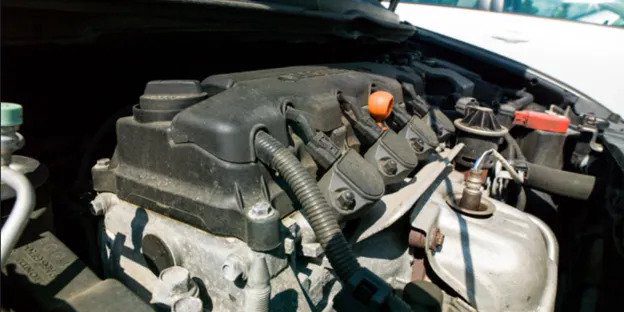
Has your car been leaving oil spots in the driveway? If so, switching to high mileage oil may be exactly what your vehicle needs.
Making the transition to high mileage oil for an aging vehicle is one of the most important steps you can take to preserve engine health over the long haul. Unlike conventional oils, these formulations contain seal enhancers and specialized additives engineered to reduce both internal and external engine oil leaks.
To address oil leaks and oil burning — both common issues in older engines — we recommend choosing a high mileage oil that causes your engine's o-rings, gaskets, and seals to expand and reseal.
High mileage oils are formulated specifically for engines that have logged considerable distance — generally those with 75,000 or more miles on the odometer. While the choice to make this switch ultimately rests with the vehicle owner, the consensus among automotive experts strongly favors doing so once you pass that mileage threshold.
That said, vehicles experiencing combustion gas blowby past the piston and cylinder wall into the crankcase, or those suffering more serious damage such as power loss or cylinder slap, will not be remedied simply by switching oil types. These conditions most likely indicate mechanical failures that require a visit to a qualified mechanic.
Conversely, well-maintained high mileage engines stand to gain significant benefits from high mileage oils, particularly when it comes to limiting ongoing engine wear.
A question we frequently encounter is: How long can a car actually last? Or put another way: what exactly qualifies as 'high mileage'?
There is no universal answer that applies to every situation. As noted above, 75,000 miles (or approximately 121,000 kilometers) is widely accepted as the threshold at which most cars earn the 'high mileage' designation.
That said, no hard-and-fast rules define when a vehicle crosses into high mileage territory. Certain experts argue the threshold should be as low as 45,000 miles, pointing out that with diligent maintenance, a car can realistically reach a life expectancy of around 200,000 miles. Meanwhile, modern standard road vehicles equipped with today's technology are capable of traveling up to 400,000 miles.
Most drivers intuitively understand that city driving and highway driving are not equivalent experiences.
Beyond fuel consumption differences, the strain placed on engines varies considerably. As multiple research studies have documented, highway driving is considerably less taxing on engines than city driving in terms of wear and tear.
The reason is straightforward: highway driving keeps engine temperatures steady, allows the engine to operate at peak efficiency, and involves far fewer starts and stops. City driving, by contrast, subjects the engine to constant fluctuations in performance demands. As a result, an engine with 75,000 city miles may be comparably worn to one with 150,000 highway miles.
Naturally, a range of additional variables also comes into play, including:
Taking all of these factors into account, you will need to assess whether the time has come to switch your specific engine to high mileage oil.
Note: While some drivers delay the switch until 200,000 miles and others make the change as early as 80,000 miles, the generally accepted recommendation for most drivers is to transition to high mileage oil at the 100,000-mile mark.
Much as with conventional engine oils, high mileage oils are available with a wide variety of additive packages that can appear nearly identical on the surface, making it difficult to assess the true differences between products.
Additive concentration represents one of the primary distinguishing factors among the many high mileage oils on the market. However, because precise oil formulations and compositions are closely guarded as proprietary trade secrets, it is virtually impossible to determine the exact quantity of additives in any given motor oil. Safety data sheets can offer some insight, but they only provide additive percentage ranges, and certain additives may be omitted entirely due to limited regulatory oversight.
The fundamental distinction between standard motor oils and high mileage variants typically lies in additives designed to reduce roughness on metal engine surfaces by filling microscopic cracks, thereby producing smoother mechanical contact.
This question is more nuanced than it might initially appear. Perspectives vary widely — both online and at local repair shops — and given the number of variables involved, it is strongly advisable to gather as much best-practice information as possible and evaluate it in the context of your particular situation.
Two opposing viewpoints tend to dominate the conversation online:
1. The first position holds that oil changes should become more frequent as a vehicle accumulates miles. The reasoning is that looser engine tolerances can lead to soot ingression and blowby.
2. The second position argues the reverse: that oil change intervals should actually lengthen as engine mileage increases. Proponents of this view contend that break-in wear is largely unavoidable and that car owners have little reason to be concerned about warranty implications.
The reality is that neither camp is entirely correct or entirely wrong.
Engines that have been well cared for and consistently maintained should, in principle, tolerate longer oil change intervals. As engines break in, surfaces and edges become polished down, allowing metal components to mate more precisely and reducing the likelihood of metal-to-metal contact.
If you want to evaluate whether your high mileage oil change intervals can safely be extended, a comprehensive oil analysis test is the most reliable method. A simpler alternative is the 'blotter spot' test, which can reveal whether fuel dilution or coolant has entered the motor oil.
In general, extending high mileage oil change intervals is not recommended in the following circumstances:
High Mileage Synthetic Oils are purpose-built for high-mileage vehicles requiring synthetic formulations with additional seal conditioner, delivering enhanced protection to aging seals and helping to reduce leaks in worn engines.
Drivers who switch to high mileage synthetic oil may occasionally encounter leakage, which can result from incompatibility between the synthetic base used in certain oils and the engine's seal materials. Leaks can also occur when the oil cleans away residue deposits that had been inadvertently sealing existing leak points. This is relatively uncommon today, as modern synthetic oils have been refined over time to minimize this problem.
Regardless, it is strongly advisable to consult the engine's owner's manual or get guidance from a qualified repair technician before making the switch.
The concise answer is: it is not recommended, and there is no practical need for it.
While using high mileage oil in a low-mileage engine will not cause engine damage, the best course of action is generally to follow the specifications outlined in the owner's manual — at minimum until the vehicle's warranty period has expired.
The fuller explanation involves a complex landscape of international standards, oil classifications, licensing systems, and approval categories. To illustrate, the AAMA (American Automobile Manufacturers Association) and JAMA (Japan Automobile Manufacturers Association) collaborated to establish the global standard for engine oils.
Additionally, the Engine Oil Licensing and Certification System was developed by The International Lubricant Standardization and Approval Committee (ILSAC), working alongside the API, ASTM, and SAE. This system gave rise to the starburst symbol and the API service symbol displayed on oil bottles, confirming that the oil has been formulated, tested, and approved in accordance with manufacturer requirements. Evolving standards in fuel economy, metallurgy, and engine technology continue to shape motor oil classifications, which is why reading product labels and staying current with developments in engine technology remains essential.
The current API service classification standard for gasoline engines is SN or SN Plus, while the cold weather viscosity suffixes 0W, 5W, 10W, 15W, and 25W indicate low-temperature performance. A 0W oil, for instance, will deliver superior performance in cold conditions compared to a 25W product. The number following the 'W' indicates hot weather viscosity, reflecting how the oil behaves under high-temperature operating conditions.
The two most commonly used oil grades today are 5W-30 and 10W-30.
For diesel engines, most four-stroke vehicles currently rely on CK-4 classification oils, while newer low-sulfur diesel engines from 2017 onward may call for FA-4 classified oils, which are formulated to support reduced greenhouse gas (GHG) emissions.
Newer motor oil classifications are designed to be backward compatible, meaning oils meeting newer category standards can generally be used safely in older vehicles. However, using an older service category oil in a newer vehicle may introduce compatibility problems.
Group I base oils contain 90% or lower saturates and/or more than 0.03 percent sulfur, with a viscosity index ranging from 80 to 120. As the least refined option, they are also the most affordable base oils available. Due to their irregular molecular structure, Group I oils generate higher friction and are primarily suited to less demanding applications.
Group II base oils are characterized by saturate content of 90% or more, sulfur content of 0.03 percent or less, and a viscosity index between 80 and 120. Produced through hydrocracking — a refining process that breaks large hydrocarbon molecules into smaller ones — Group II oils offer improved antioxidation properties.
Group III base oils contain 90% or more saturates, 0.03% or less sulfur, and a viscosity index of 120 or greater. They are produced through severe hydrocracking, an intensive process applying higher levels of pressure and heat that yields a purer, higher-quality base oil.
These oils, classified as polyalphaolefins (PAOs), are synthesized from small, uniform molecules. Their defining advantage is that PAOs can be engineered to exhibit specific, predictable structural properties. Group IV oils perform exceptionally well across a wide range of extreme temperatures, both hot and cold.
Group V encompasses all base oil types not covered by the preceding four groups. These oils are most commonly employed as additive components blended into other base oils.
Valvoline's core mission is to deliver only the highest-quality products to vehicle owners. Our lineup includes premium oils, coolants, and other fluids engineered to help your vehicles and equipment reach peak performance and extend their operational lifespan. With a heritage spanning more than 150 years, customers continue to trust Valvoline because our products are consistently developed and validated to the most rigorous standards.
Valvoline lubricants represent the culmination of unwavering dedication, deep industry experience, and continuous innovation, backed by advanced technology in both product development and testing. Every lubrication fluid in our range is carefully selected and field-tested by our specialized research teams. We conduct testing within state-of-the-art facilities to ensure our products consistently deliver maximum performance, minimal downtime, and optimized operational costs.
The Valvoline Europe team places your needs at the center of everything we do. Always.
Valvoline MaxLife™ engine oil is a premium product within the Valvoline™ engine oil lineup, specifically engineered to meet the demands of high-mileage engines.
Its synthetic formulation, enhanced with a precisely engineered system of advanced additives, is tailored to address the particular requirements of vehicles that have covered significant distances. Valvoline MaxLife engine oil restores vital engine components, delivers optimal lubrication, and works to extend both the life and performance of your engine.





No letters yet — pray write the first.