You've probably heard that every tire should be inflated to the number printed on its sidewall. That number isn't usually the target for your car. So what is the best tire pressure? For ordinary driving on the vehicle's specified tires, use the cold PSI listed on the driver's doorjamb placard. Check the front and rear values separately; they can differ. The owner's manual may provide additional instructions for different loads or driving conditions.
Here's the distinction: the vehicle manufacturer specifies a pressure for the vehicle and its intended load, while the tire sidewall identifies a maximum pressure associated with the tire's load rating. Treating those two numbers as interchangeable can leave you with an unnecessarily harsh ride and different handling than the manufacturer intended.
Find the right PSI before reaching for the air hose
Open the driver's door and look for the tire and loading information label on the doorjamb or door edge. It normally lists recommended cold pressures for the original tire sizes. You may see one value for the front axle and another for the rear, plus a separate value for the spare if the vehicle has one.
For example, if a placard says 35 PSI front and 33 PSI rear, those are the targets for that particular vehicle under the conditions specified on its label. They aren't universal numbers. A pickup, a small sedan and an SUV may all call for different pressures, and two versions of the same vehicle can have different recommendations.
If the label is missing or unreadable, consult the owner's manual or ask a dealer to identify the correct specification for your vehicle. Don't copy a number from a similar-looking car in the parking lot.
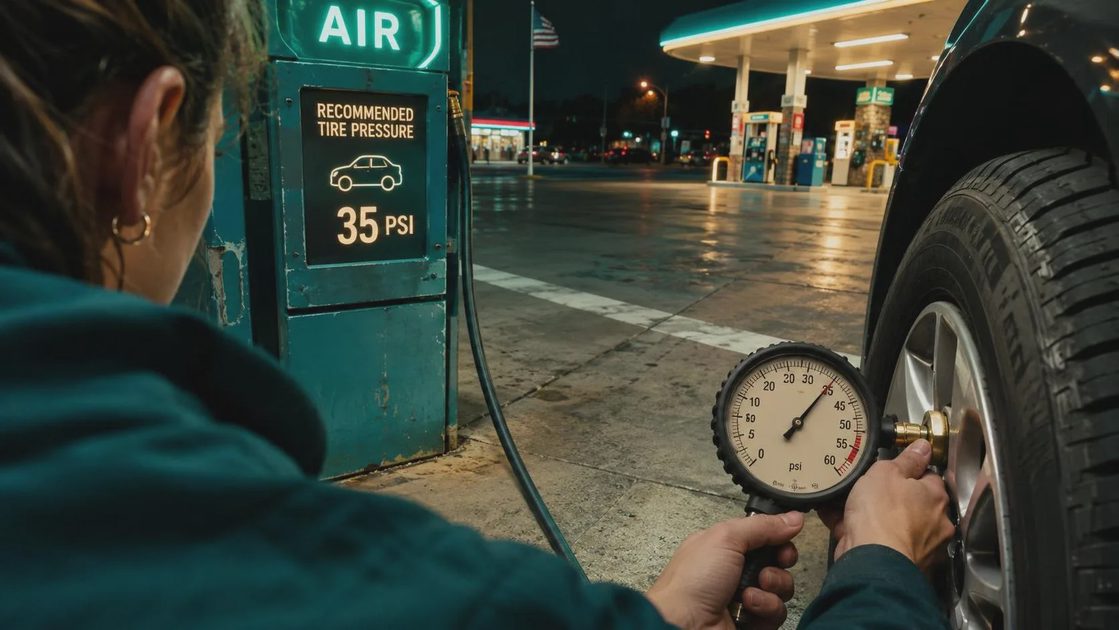
If you have changed tire size, load range or wheel setup, the original placard may not tell the whole story. Ask a qualified tire professional to determine an appropriate pressure for the replacement tires and the vehicle's axle loads. Don't guess based only on the new tire's sidewall maximum.
What is the best tire pressure when tires are warm?
The best target is still the manufacturer's cold specification, but a warm reading needs interpretation. Check pressure before driving, ideally after the vehicle has been parked for at least three hours. If you must drive to an air pump, measure at home first and note how much air each tire needs.
Driving flexes the tire and warms the air inside, raising its pressure. Don't bleed air from a warm tire just because its reading is above the cold target; it may end up underinflated once it cools. If a tire needs air while warm, add the amount it was short when cold, then recheck it cold later.
Science Corner: Air pressure comes from gas molecules colliding with the inside of the tire. As the air warms, those collisions become more energetic. A tire also changes shape slightly, so the pressure change isn't a perfectly fixed number for every situation. Ambient temperature, sunlight and recent driving all affect the reading.
As a practical rule of thumb, a 10-degree Fahrenheit change in ambient temperature can change tire pressure by roughly 1 PSI. That's a guide, not a calibration formula. When a cold snap arrives, measure rather than assuming the dashboard warning light will catch every tire that needs attention.
How to check and adjust pressure accurately
Use a tire-pressure gauge that reads in PSI and has a range suitable for your vehicle. Unscrew the valve cap, press the gauge squarely onto the valve stem and read the number. A brief hiss as the gauge seats is normal; a continuous hiss means it isn't sealed squarely.
Compare the reading with the correct front or rear placard value. Add air in short bursts, checking between bursts. If a cold tire goes above its target, press the valve core briefly to release a little air and measure again. Replace the valve cap when finished; it helps keep dirt and moisture out of the valve.

Check all four tires at least monthly and before a long trip. Check the spare on its own schedule too, using its specified pressure: a temporary spare can require a different value from the road tires. A missing or damaged spare is worth discovering in the driveway, not on the shoulder.
If one tire repeatedly loses pressure, have it inspected for a puncture, valve problem or leak at the wheel. Adding air is a temporary correction, not a repair. A visibly damaged tire, a bulge or a tire driven significantly underinflated deserves professional attention before further driving.
Loads, TPMS and the limits of the placard
Some vehicles specify different pressures for heavy loads or sustained high-speed driving. Follow the applicable label or owner's-manual instructions, and stay within the vehicle's tire and axle load limits. More pressure does not increase the vehicle's rated carrying capacity. Towing also calls for attention to the tow vehicle's instructions and the trailer tire's own pressure and load requirements.
The tire-pressure monitoring system, or TPMS, is a warning system, not a substitute for a gauge. A warning light can mean a tire is significantly low, but it may not illuminate for a smaller pressure loss that still takes a tire below its recommended setting. Check every tire with a gauge when the light comes on, correct the pressures when possible, and follow the manual's reset or relearn instructions if applicable.
Underinflation increases tire flex and heat buildup; overinflation can reduce ride comfort and alter the contact patch. Either condition can affect wear and handling. The precise result depends on the tire, vehicle and degree of misinflation, so a wear pattern alone doesn't prove a pressure problem. Alignment, rotation and worn suspension parts matter too.
If you remember one number from this post, make it the cold PSI on your own doorjamb—not a number copied from the tire sidewall or another vehicle. Check it with a gauge, and give each axle the pressure its label calls for.


No letters yet — pray write the first.