You’ve probably heard that a car that starts and stalls must need a new fuel pump. Not so fast. If you’re thinking, “my car starts but wont stay running,” the useful answer is that the engine may be losing fuel, air, spark, or authorization from the security system. Start with the warning lights and the timing of the stall, then check for trouble codes. Replacing parts before those checks can turn a manageable diagnosis into an expensive guessing game.
Start with safety and the symptom
If the engine stalls in traffic, steer to a safe location, turn on the hazard lights, and call for help if you cannot get clear of the roadway. Steering and braking assistance may decrease when the engine stops, so both controls can require more effort. Don’t keep trying to drive a car that stalls unpredictably.
A flashing check-engine light, strong fuel smell, visible fuel leak, smoke, or loud mechanical knocking is a reason to shut the engine off and arrange a tow. Never run the engine in a closed garage, even with the door open: exhaust contains carbon monoxide, which you cannot see or smell.
Now note exactly what happens. Does it fire for a second and die cleanly? Does it idle roughly before stopping? Will it stay running only with light pressure on the accelerator? Did the problem begin immediately after refueling, a battery replacement, or maintenance? Those details help separate an intermittent supply problem from an airflow, electrical, or security issue.
Why my car starts but wont stay running
An engine needs the right mixture of air and fuel, ignition at the right time, adequate compression, and functioning electronic controls. A brief start tells you that at least some of those conditions existed momentarily; it does not prove they remain present.
Fuel delivery is one possibility. A weak pump, restricted filter where serviceable, pump-control problem, or insufficient fuel in the tank can interrupt operation. A fuel gauge can be wrong, so consider whether the car may actually be low. Avoid repeated cranking while you guess: it drains the battery and can complicate diagnosis.
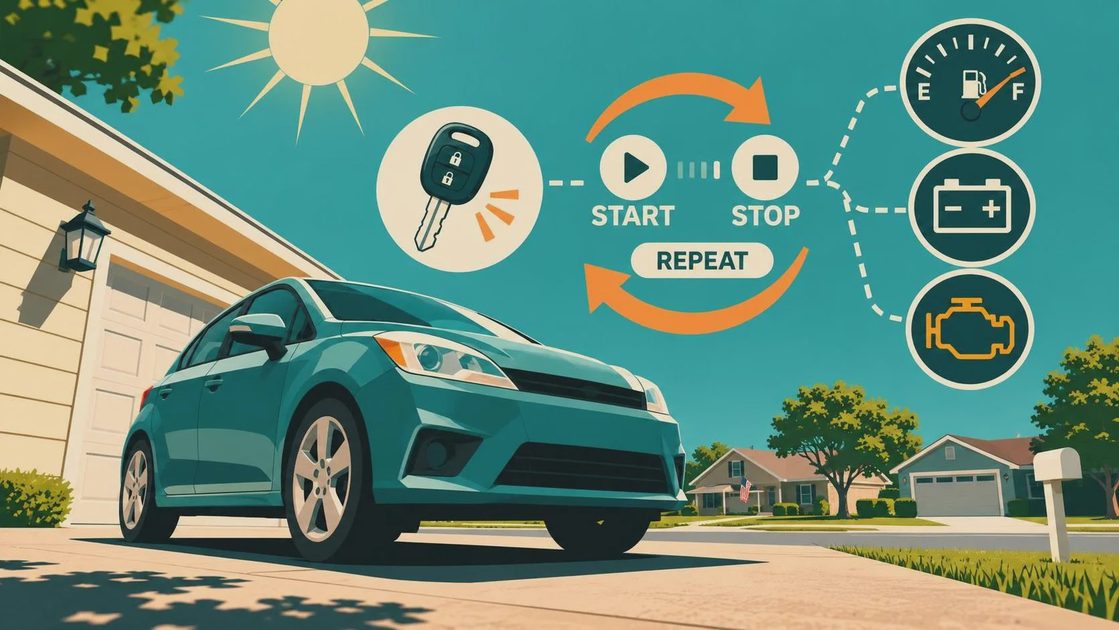
Airflow is another possibility. A disconnected intake duct or a significant vacuum leak can let in air the engine computer has not accounted for. A dirty throttle body or an idle-control problem can also contribute to stalling, particularly when the engine will run with a little throttle but not at idle. That symptom is a clue, not proof that cleaning a part will fix it.
Electrical faults can look similar. Loose or corroded battery connections, a faulty sensor signal, ignition trouble, or a wiring problem can interrupt operation. An illuminated security indicator and an engine that starts briefly and then dies may point toward an immobilizer issue. Try a spare programmed key if you have one, and check the owner’s manual for the meaning of the security light.
Read the codes before buying parts
If the check-engine light is on, connect an OBD-II scan tool to the diagnostic port and record every stored and pending code, along with any freeze-frame data the tool provides. Many scan tools can read generic powertrain codes, although access to manufacturer-specific systems varies. A security fault, for example, may require equipment that can communicate with additional modules.
A code identifies a system or condition the computer detected; it does not automatically condemn the part named in its description. A lean-mixture code, for instance, can accompany an intake leak or a fuel-delivery problem. Don’t clear codes before recording them, because you may erase useful clues.
No check-engine light does not rule out a fault. If there are no useful codes, a technician can check live sensor readings, fuel pressure, and ignition signals against the vehicle’s service specifications. Fuel-pressure testing involves pressurized, flammable fuel, so leave it to a qualified technician if you lack the correct equipment and procedure.
Science Corner: What oil can and cannot tell you
Oil is essential to engine survival, but it is not the first explanation for an otherwise normal start followed by an immediate stall. Low oil level or loss of oil pressure can cause severe damage, and some vehicles may have protective strategies; the exact response depends on the vehicle. Don’t assume a stalling engine is protecting itself, and don’t ignore an oil-pressure warning.
With the engine off and parked on level ground, follow the owner’s manual to check the oil level. If it is below the marked range, add the specified oil in small amounts and recheck. If the red oil-pressure warning stays on while the engine is running, shut it down promptly and arrange for diagnosis. A level check cannot establish whether the oil pump is producing adequate pressure.

Viscosity grades such as SAE 0W-20 describe how an oil flows under specified test conditions; API service categories describe performance requirements. Use the grade and specification called for in your manual, but don’t expect an oil change, thicker oil, or an additive to repair a fuel or ignition fault. If the oil smells strongly of gasoline or the level has risen unexpectedly, mention it to the technician: fuel dilution can reduce viscosity and may accompany an underlying running problem.
What to tell the repair shop
Give the technician the sequence rather than a diagnosis: “Starts, runs for two seconds, then stops,” is more useful than “It needs a pump.” Include whether the stall happens hot or cold, any warning lights, recent repairs, and the codes you recorded. If the problem began after refueling, say so; the timing may matter, but it does not establish the cause.
Ask for the failed test or measurement before authorizing a major replacement. A fuel-pressure reading outside the specified range, followed by electrical checks at the pump, is more informative than replacing a pump based on symptoms alone. The same principle applies to sensors: wiring, power supply, and the signal itself deserve attention.
If the engine will not idle reliably, have it towed rather than trying to nurse it through traffic. A clear symptom description and preserved codes give the shop a better starting point—and give you a better chance of paying for the repair the car actually needs.

No letters yet — pray write the first.