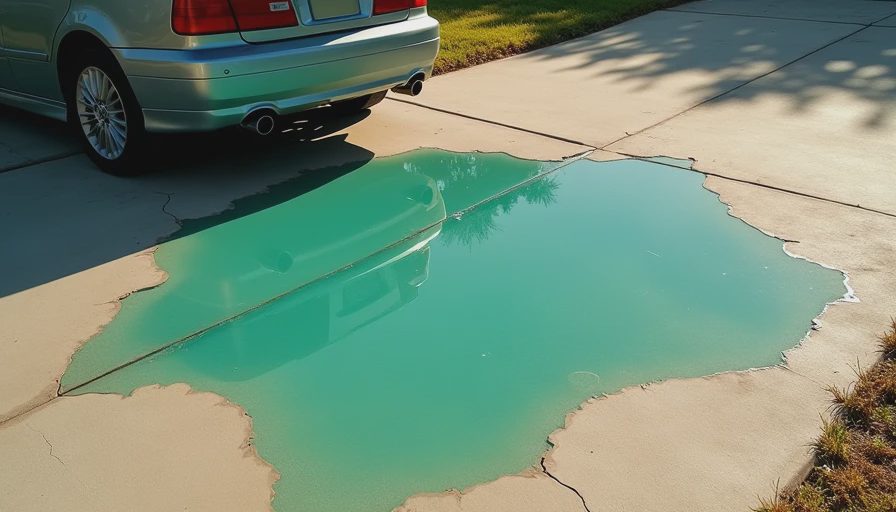
You've probably heard that any **clear oil puddle under car** means an engine oil leak. Here's what the data actually shows: fresh engine oil is usually amber, not water-clear, and many puddles people call "oil" turn out to be condensation, fuel residue, power steering fluid, or a very light new lubricant film mixed with road grime. Before you panic, the smart move is to identify the fluid by color, feel, smell, and location. A five-minute check in your driveway can tell you whether you're looking at something harmless or the early warning sign of a leak that can get expensive fast.
Start With the Obvious: Is It Really Oil?
The phrase **clear oil puddle under car** is a little misleading because true motor oil rarely stays clear for long. Even fresh oil picks up dye tone and quickly darkens once it circulates through the engine. If the puddle looks almost like water, first consider air conditioner condensate. That is the most common innocent drip, especially in warm weather after a drive with the A/C running. It will usually appear near the passenger side firewall area and feel thin, with no slick rainbow film.
If the fluid is slippery, then you need to look closer. New engine oil can appear pale honey or nearly transparent in a thin smear on concrete. Automatic transmission fluid can be pinkish or red when fresh, but age and dirt can make it harder to identify. Brake fluid is often clear to light amber and feels slick, though not as oily as engine oil. Coolant may also look clear at first glance unless the light catches its green, orange, or pink tint.
A plain white paper towel is one of the best diagnostic tools here. Blot the puddle, then compare color, smell, and spread pattern. Oil tends to leave a greasy ring and spread slowly. Water evaporates. Fuel flashes off faster and has a sharp smell. Read the spec, not the bottle: identification starts with properties, not assumptions.
Use Location to Narrow the Source
Where the puddle sits under the vehicle matters almost as much as what it looks like. A **clear oil puddle under car** near the middle front can point toward engine oil, especially if the drain plug, oil filter, or lower oil pan gasket has a seep. If it is farther back on a rear-wheel-drive vehicle, transmission fluid becomes more likely. Near a wheel, you might be dealing with brake fluid from a caliper, hose, or wheel cylinder, and that is not something to postpone.
On front-wheel-drive cars, leaks can travel along splash shields and subframes, which makes the drip point misleading. I see this mistake all the time: the puddle forms three feet away from the actual source. Use a flashlight and inspect upward from the wet spot. Look for fresh wetness around the oil pan perimeter, filter housing, valve cover area, CV axle seals, and transmission case seams.
If the underside is dirty, clean the suspected area with degreaser, drive briefly, and recheck. That simple reset often reveals the origin better than guessing from the floor. If the fluid is collecting only after parking overnight, place cardboard under the car and mark the drip position relative to the front wheels. That gives you a crude but useful map.
Science Corner: Why Some Oil Looks Almost Clear
Science Corner: fresh lubricants are blends of base oils plus an additive package. Base oils themselves can be very light in color, especially highly refined Group II, Group III, or PAO-based formulations. In a thin film, these can look nearly clear on concrete. That is why a **clear oil puddle under car** does not automatically rule out engine oil.
What changes the appearance is oxidation, contamination, and additive chemistry in service. Detergents and dispersants hold soot and oxidation products in suspension, which darkens used oil. Anti-wear additives such as zinc dialkyldithiophosphate do not make the oil obviously colored to your eye, but service exposure does. Viscosity grade also affects how the fluid behaves on the ground. A 0W-20 fresh leak may spread faster and look thinner than an older 15W-40 seep, even if both are engine oil.
If you remember one number from this post, make it this one: viscosity is measured in centistokes, and fresh engine oils of different grades can still appear deceptively similar in a driveway puddle. That is why touch, odor, and source location matter more than color alone.

When a Small Leak Is Serious
Not every drip is an emergency, but some are. If the **clear oil puddle under car** turns out to be brake fluid, stop driving until it is fixed. Brake fluid leaks can reduce hydraulic pressure and directly affect stopping performance. If it is engine oil and the puddle grows from dime-sized spots to palm-sized spots over a few days, the leak is no longer trivial. Low oil level can starve timing components, turbo bearings, or the oil pump pickup during hard braking and cornering.
Transmission fluid leaks also deserve quick attention because even a modest loss can change shift quality and accelerate wear. Power steering fluid is another one drivers ignore too long; low fluid can damage the pump and create noise well before total failure.
The practical threshold is simple: if fluid loss is enough to noticeably drop the reservoir or dipstick level between normal checks, fix it now. Also pay attention to smell and smoke. Oil dripping onto a hot exhaust can create burnt-oil odor and, in extreme cases, a fire risk. A slow seep is a maintenance item. An active drip plus falling fluid level is a repair priority.
What to Check Before You Call a Shop
Before paying for diagnosis, do a short inspection. Check engine oil level on the dipstick with the car parked level. Inspect the oil filter for wetness around the gasket. Look at the drain plug for fresh fluid trails. Scan the valve cover perimeter and timing cover area for seepage running downward. If your vehicle uses an undertray, remove only what you can safely access and look for pooling.
Also check the brake master cylinder reservoir, coolant reservoir, and power steering reservoir if equipped. Many newer vehicles use electric power steering, so that system may not apply. For automatic transmissions without a dipstick, look for wet case seams or fluid near axle seals. Do not crawl under a car supported only by a jack.
When you do call a shop, give useful information: where the drip lands, whether it appears after driving or overnight, whether the A/C was on, and whether any warning lights are present. That saves time and usually shortens diagnostic labor. The goal is not to become your own mechanic. It is to separate harmless condensation from a leak that can damage expensive hardware.
The Bottom Line on a Clear Puddle
A **clear oil puddle under car** is not a diagnosis by itself. It is a clue. Most often, truly clear drips are condensation or another light fluid, but fresh oil can look much clearer than people expect, especially in a thin smear. The disciplined approach is to identify the fluid, trace the location, monitor the level, and act based on risk.
Skip the guesswork. Blot the puddle, inspect upward, and check your fluid levels today. If the spot keeps returning or any reservoir drops, schedule a repair before a small leak becomes engine wear, brake trouble, or transmission damage. You've probably heard that all drips are the same. Here's what the data actually shows: properties, source, and rate of loss tell the real story.




No letters yet — pray write the first.