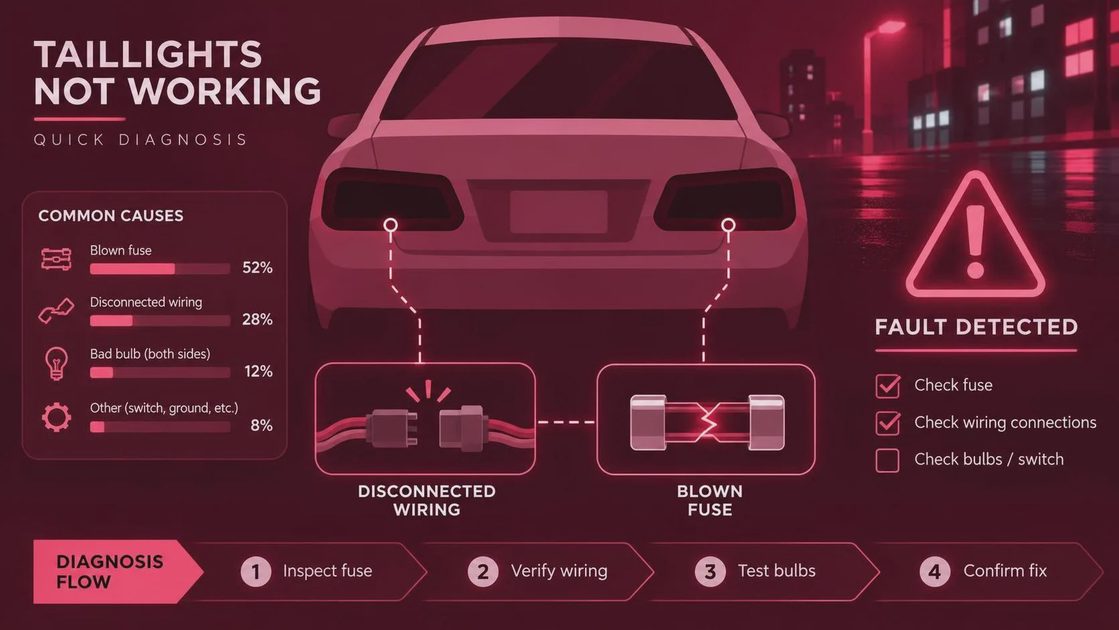
You've probably heard that a dark rear lamp simply means a burned-out bulb. Here's what the data actually shows: no rear lights working can come from a fuse, bad ground, damaged wiring, a failed switch, or a control-module fault. The right diagnosis matters because driving without visible tail lamps makes it harder for following drivers to judge your speed and distance, especially after sunset or in rain.
Why no rear lights working is a safety problem
Tail lights are not the same as brake lights, although both use the rear lamp assemblies on many vehicles. Tail lights turn on with the headlight or parking-light circuit. Brake lights become brighter when you press the pedal. Turn signals usually operate on a separate circuit, but modern LED assemblies and body-control modules can combine several functions in one unit.
If only one bulb is dark, a failed bulb or socket is a reasonable first suspect. If both sides stopped working together, the problem is more likely upstream. Common causes include a blown fuse, a loose connector, corrosion in a ground point, trailer wiring damage, or a fault in the headlight switch. On newer vehicles, a body-control module can also shut down a circuit after detecting a short.
The safest response is not to keep driving and hope the lamps return. Move to a well-lit location if possible, turn on hazard flashers while stopped, and arrange roadside help or a repair. Hazard flashers are useful for warning traffic, but they do not replace functioning tail lamps when the vehicle is moving.
A quick diagnostic sequence
Start with the easy observations. Turn on the headlights and walk behind the vehicle. Check whether the license-plate lights, dashboard illumination, front parking lights, brake lights, and turn signals behave normally. This comparison helps separate a lighting-control problem from a rear harness problem.
Next, inspect the owner’s manual for the fuse locations and labels. A fuse that has opened because of an electrical short should be replaced only with the same amperage rating. Installing a larger fuse can overheat wiring and create a fire risk. If the replacement blows immediately, stop testing and have the circuit diagnosed.
Inspect bulb sockets for green or white corrosion, heat discoloration, bent contacts, and water intrusion. On an LED assembly, there may be no replaceable bulb. The repair could involve a connector, circuit board, or complete lamp housing. Do not probe random terminals with a test light if the vehicle uses sensitive electronics; a technician can use a wiring diagram and a fused meter safely.
What to do when no rear lights working leaves you stranded
If you discover no rear lights working in your driveway, avoid driving at night until the fault is repaired. During daylight, a short trip to a repair shop might still be unsafe or unlawful depending on the vehicle’s condition and local rules. A tow is often cheaper than a traffic stop, a rear-end crash, or damage caused by an improvised wiring repair.
Roadside assistance can be useful here. Coverage might come from an auto insurance endorsement, a motor club, a vehicle manufacturer plan, or a credit-card benefit. Typical services include towing a limited distance, jump-starting, changing a tire, or arranging help at the scene. Roadside coverage generally does not pay for the replacement bulb, wiring diagnosis, fuse, or lamp assembly itself.
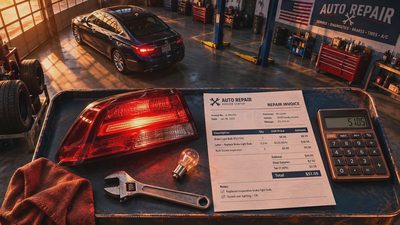
Repair pricing depends heavily on the vehicle. A simple incandescent bulb and fuse may cost roughly $10 to $40 if you do the work yourself. A shop diagnosis can run about $80 to $180, while wiring repairs commonly range from $100 to $400. A sealed LED lamp assembly for a newer SUV or luxury vehicle can push parts and labor beyond $500. Ask for the diagnostic fee, the failed component, and the warranty period before approving work.
Can auto insurance cover no rear lights working?
Insurance is designed mainly for sudden, covered losses, not ordinary maintenance. If no rear lights working results from a worn bulb, corroded connector, aging wiring, or an internal electronic failure, comprehensive and collision coverage normally do not pay for the repair. Those are mechanical or electrical maintenance issues, and the cost usually belongs to the vehicle owner.
The answer changes when an outside event caused the damage. Comprehensive coverage can apply to certain non-collision losses, such as vandalism, theft-related damage, falling objects, fire, or weather events, subject to your deductible and policy terms. Collision coverage may apply if another covered accident damaged the rear body, lamp housing, or wiring. For example, a backing collision that breaks the tail-light assembly is different from an LED module that simply stops operating after years of use.
Photograph the damage, keep the repair estimate, and avoid discarding broken parts if a claim could be relevant. Report the facts accurately rather than describing an electrical failure as crash damage. A deductible of $500 or $1,000 can make a small lighting repair uneconomical even when coverage exists.
How to prevent another rear-light failure
Prevention starts with inspection, not a bottle of miracle electrical cleaner. During each oil change, check the rear lamps for condensation, cracked lenses, loose mounting points, and melted plastic around the socket. Test the headlights, tail lights, brake lights, turn signals, reverse lights, and license-plate lamps before a road trip.
Trailer wiring deserves special attention. A poorly installed four-pin or seven-pin connector can introduce corrosion or a short into the vehicle’s lighting circuit. Look for crushed insulation, exposed copper, and adapters that hang near the exhaust or suspension. If a trailer fault repeatedly blows the fuse, disconnect the trailer before replacing anything and diagnose both sides of the connection.
Use the vehicle’s specified bulb type and wattage. A bulb that fits physically but draws the wrong current can create heat or trigger fault monitoring. LED conversions can also produce warning messages or rapid flashing if the vehicle’s control system expects a different electrical load. Read the owner’s manual and the lamp manufacturer’s specifications instead of relying on package appearance.
A practical decision before you drive
When no rear lights working appears on a dark road, first get out of traffic and make the vehicle visible with hazard flashers. Confirm whether brake lights and turn signals work, but do not assume that partial operation makes nighttime driving safe. Call roadside assistance or a tow provider if the fault cannot be corrected with a properly rated fuse or an accessible bulb.
For the repair, request a circuit diagnosis rather than a parts-swapping guess. A competent technician should identify power, ground, fuse condition, connector integrity, and control signals. If the issue followed a collision, storm, vandalism, or another sudden event, ask your insurer whether the damage fits comprehensive or collision coverage and compare the estimate with your deductible.
The useful lesson is simple: no rear lights working is an electrical safety fault first and an insurance question second. Read the wiring evidence, use the correct replacement parts, and repair the cause rather than repeatedly replacing fuses. Read the spec, not the bottle—and in this case, read the circuit diagram, not the guess.
No letters yet — pray write the first.