You've probably heard that any clicking from the front end means a bad wheel bearing. Here's what the data actually shows: cv shaft failure symptoms usually change with steering angle, throttle position, or suspension movement. A wheel bearing tends to produce a steady hum that follows road speed. Those differences matter because a CV axle, bearing, and suspension joint can produce similar complaints but require entirely different repairs.
A CV shaft, commonly called a CV axle, transfers power from the transaxle or differential to a driven wheel while allowing the suspension to move and the steering to turn. Most use an outer constant-velocity joint near the wheel and an inner joint near the transmission. Both joints rely on precision-machined tracks, ball bearings, grease, and a flexible boot. When that system loses lubrication or develops wear, the symptoms become progressively easier to identify.
The most common CV shaft failure symptoms
The classic outer-joint symptom is a rhythmic clicking or popping during a tight, slow turn under light acceleration. Pull into an empty parking lot, turn the steering wheel nearly to full lock, and drive a small circle in both directions. A worn outer joint often clicks more loudly when the damaged joint is loaded on the outside of the turn. Do not treat this test as proof by itself, but a repeatable click that rises with wheel rotation is a strong clue.
A shudder during acceleration is more commonly associated with an inner CV joint. You may feel vibration through the floor or seat between roughly 20 and 45 mph, especially when climbing a hill or applying firm throttle. If the vibration fades when you lift off the gas, drivetrain play deserves attention. An out-of-balance tire usually continues vibrating at a similar road speed regardless of whether the engine is pulling.
A torn CV boot is an earlier and less dramatic warning. Look behind the wheel for a rubber accordion boot split at a fold, loose clamp, or streaks of dark grease on the control arm, wheel barrel, or nearby suspension parts. Once dirt and water enter, the grease becomes contaminated and the joint's hardened steel surfaces begin wearing. Replacing only the boot can be economical when the joint is still quiet and smooth. Clicking or grinding usually means the joint itself has already suffered damage.
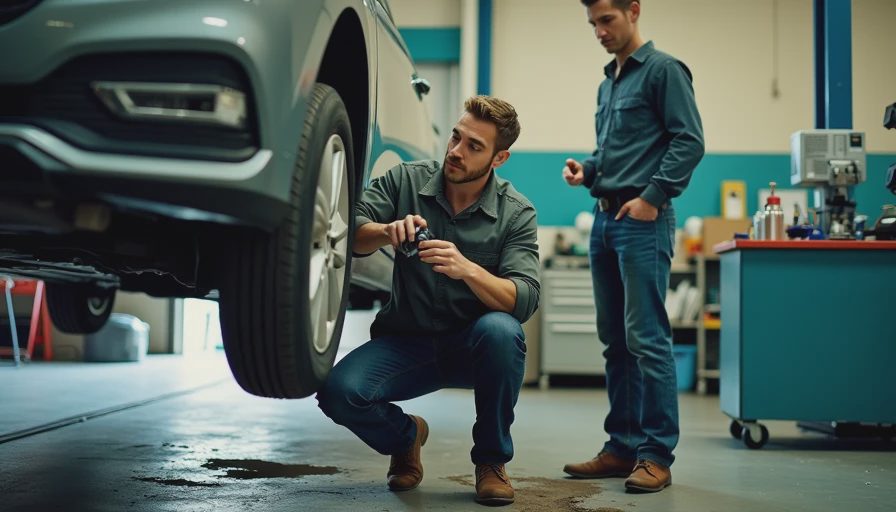
What cv shaft failure symptoms sound and feel like
Noise location can help, but sound travels through the subframe, so your ears are not a measuring instrument. An outer CV joint generally clicks on turns. An inner joint may clunk when shifting from reverse to drive or when transitioning quickly between acceleration and coasting. A failing axle can also produce a single knock when torque reverses, although worn engine mounts, differential mounts, or loose suspension hardware can do the same thing.
Science Corner: the constant-velocity joint is not simply a universal joint with a different name. Its ball-and-track geometry keeps the input and output shafts turning at nearly the same angular velocity while operating at an angle. Wear creates clearance where smooth contact is required. Under torque, the balls move across those worn areas, producing the click, clunk, or vibration you feel.
Grease type matters here, but adding random lubricant through a torn boot is not a repair. CV joints use a high-load grease formulated for sliding and rolling contact, often containing extreme-pressure additives such as molybdenum compounds. The grease is not interchangeable with ordinary chassis grease in every application. The correct replacement part should include the specified boot grease and clamps.
How to inspect a CV axle safely
Start with the vehicle parked on level ground. Set the parking brake and use wheel chocks. If you need to raise the vehicle, support it with properly rated jack stands under approved points; never rely on a floor jack alone. With the wheels turned, inspect both boots using a bright light. Compare the left and right sides. A fresh spray pattern around one wheel is often more informative than a boot that merely looks old.
With the car safely supported, check for excessive movement by holding the axle near each joint and rotating it gently back and forth. Some rotational play is normal because of gear clearance, so do not condemn an axle based on movement alone. Feel for a gritty spot, binding, or a sharp clunk. Also inspect the axle nut, wheel bearing, ball joint, tie-rod end, and transmission seal area. A loose axle nut can mimic a bearing problem and is a safety concern.
A road test should be controlled and brief. Listen during slow full-lock turns, then accelerate moderately in a straight line and note whether vibration appears only under power. Do not drive a vehicle that has a loose axle, severe grinding, heavy grease loss, or a boot torn open with visible joint damage. A failed joint can leave the vehicle unable to transfer power, even if the engine continues running normally.
Separating axle trouble from other front-end problems
Wheel-bearing noise usually sounds like a growl, hum, or rumble that increases with speed. It often changes when the vehicle loads one side during a gentle lane-position change, but it does not usually create the sharp, repeating click of an outer CV joint. Tire cupping can create a similar hum, so inspect tread wear before buying parts.
A worn ball joint or tie-rod end can cause clunks, wandering, uneven tire wear, or steering looseness. Those parts affect vehicle control and should not be ignored. A transmission or differential problem may create whine or grinding that follows engine load rather than steering angle. For cv shaft failure symptoms, the most useful combination is a torn boot, turning-related click, or acceleration-only shudder. One symptom alone is not a diagnosis.
If the noise is difficult to reproduce, a repair shop can use a chassis microphone, lift inspection, or side-to-side comparison. Ask for the failed component to be shown to you and ask whether the recommendation is a boot, complete axle assembly, wheel bearing, or another part. Clear diagnosis is more valuable than a parts cannon.

Repair choices, cost, and parts quality
A boot-only repair often costs less in parts, but labor can approach the cost of a replacement axle because the joint must be removed, cleaned, repacked, and clamped correctly. A complete aftermarket axle may cost approximately $80 to $250 for many common vehicles, while labor can add roughly $150 to $400 depending on access and local rates. Dealer-supplied assemblies for luxury, performance, or unusual models can cost substantially more.
The cheapest axle is not automatically a bargain. Compare spline count, compressed length, ABS tone-ring configuration, axle nut design, and warranty. Some low-cost assemblies use inferior boots or inconsistent joint tolerances. Read the application data rather than choosing solely by a familiar logo. A reputable parts supplier should provide the correct grease, new hardware where required, and installation instructions.
Do not automatically replace both axles because one side failed. The opposite side has experienced similar mileage and conditions, so inspect it carefully, but replace it based on evidence. If one boot is recently torn and the joint remains silent, a boot service can make sense. If the joint clicks, binds, or has pitted tracks, replacement is the sensible repair.
A practical diagnosis before you spend money
Record when the noise occurs: turning left, turning right, accelerating, coasting, braking, or crossing bumps. Note the speed and whether the steering wheel is near full lock. Then inspect the boots and surrounding surfaces. This short record can prevent confusing a speed-related bearing hum with a torque-related axle shudder.
If cv shaft failure symptoms point to a damaged joint, schedule the repair before the noise becomes constant. Ask for the axle and hub area to be checked together, because a neglected axle nut or contaminated wheel bearing can create a second problem. After installation, verify that the axle nut is tightened to the vehicle manufacturer's torque specification and that the boot clamps do not contact nearby components.
The useful lesson is simple: diagnose the operating condition, not just the noise. A CV shaft is a mechanical assembly, not a lubrication additive problem, and pouring oil or spray grease near it will not restore worn tracks. Read the service information, inspect the evidence, and replace the failed component with parts that match the vehicle's actual specification.


No letters yet — pray write the first.